

Why a One Year Audio Engineering and Music Production Program Is Better Than Short Term Courses

If you’re serious about building a career through Music production courses in Bangalore, one question will follow you, how long does it actually take to learn this craft? Weekend workshops and four-week modules have their appeal. But audio engineering is not a skill you pick up in a sprint. It demands time, repetition, and exposure to real-world pressure. A one-year program delivers all three.
Why Course Duration Matters
Short-term courses cover the surface. They introduce you to a DAW, walk you through a few signal chains, and call it done. A one-year program does something different, it gives concepts time to stick. You revisit techniques across different contexts, across genres, across projects. That repetition is where understanding actually forms. The audio industry doesn’t reward people who once watched a tutorial. It rewards people who’ve done the work enough times to trust their ears.
Advanced Practical Training
A longer program allows for layered learning. In the first few months, you’re building the foundation, acoustics, signal flow, microphone placement. By mid-year, you’re applying that knowledge in more complex scenarios. Then comes the advanced work: critical listening, parallel processing, stem mastering. Short courses don’t have the runway for this. They give you tools without teaching you how to decide which tool fits the moment.
Key areas covered in depth over a one-year program include:
- Multitrack recording and session management
- Advanced mixing techniques across genres
- Mixing and mastering course components including metering, limiting, and delivery formats
- Sound design and synthesis fundamentals
- Live sound reinforcement
Industry Internship
This is where theory meets reality. A structured one-year program includes internship components that place you inside working studios, production houses, or live event setups. You’re not observing, you’re contributing. Short-term courses rarely have the institutional relationships or the program length needed to make this happen. The connections you form during an internship often become your first job leads.
Real Studio Experience
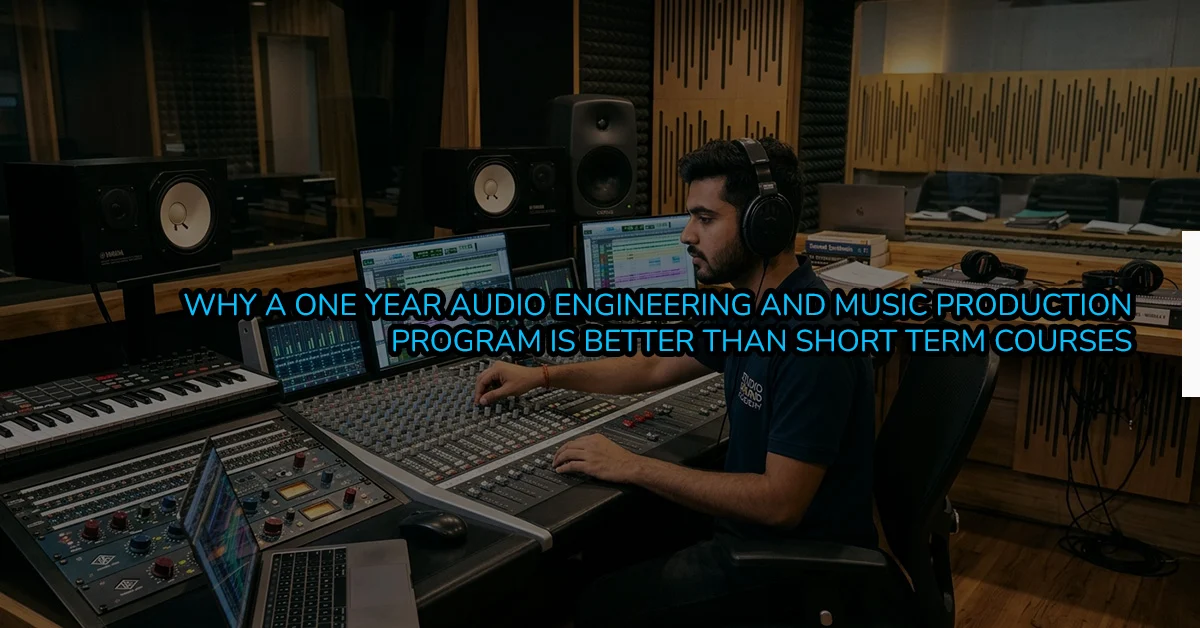
Reading about a Neve console and sitting behind one are two completely different things. A year-long music production training program gives you consistent, supervised access to professional studio environments. You learn how sessions actually run, the communication, the problem-solving under time pressure, and the way a mix sounds in a treated room versus a laptop speaker. That gap between academic knowledge and applied skill closes only through hours logged in a real studio.
Better Career Growth
Studios, post-production houses, and labels look at training backgrounds. A diploma from a structured, year-long program signals commitment and depth. It also gives you a portfolio, multiple completed projects across different formats that demonstrate range. Short-term courses produce certificates. A full program produces competence.
The Difference Is in the Depth
If you’re evaluating Music production courses in India, don’t just compare fees or schedules. Compare what you’ll actually walk away knowing. A one-year program at TASE is built to take you from curious beginner to industry-ready engineer, not just informed, but capable. That’s the standard the industry holds you to, and it should be the standard you hold your education to.