

What Happens Before a Song Reaches Spotify? The Complete Audio Production Process
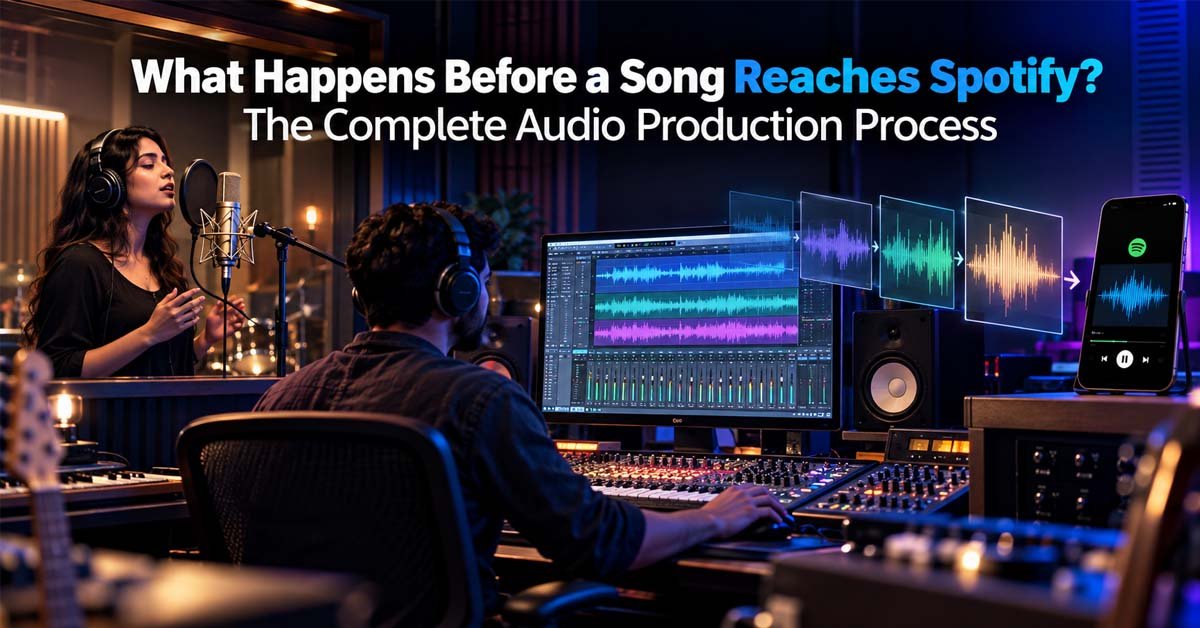

By the time a song reaches your Spotify playlist, it’s already lived through several very different rooms, several different people, and honestly, more decisions than most listeners would ever guess. Songwriting, arrangement, tracking, mixing, mastering, distribution. None of it is visible from where you’re sitting with your headphones on. But each stage quietly decides whether a track sounds like something someone recorded in their bedroom last week or something you’d actually pay to hear again. If you’ve started looking into audio engineering courses in India, maybe because you’re tired of just consuming music and want to understand how it’s actually built, you’re asking the right question at a good time. In this blog, we will take a closer look at everything that happens between an artist’s first rough idea and the moment that song lands on a streaming platform.
It Starts With an Idea, Not a Studio
Most people picture music production starting the second someone hits record. That’s not really true. Long before a microphone gets switched on, a songwriter is somewhere else entirely, wrestling with a melody that won’t quite come together or lyrics that sound good at 2am and terrible the next morning. Sometimes it’s just a voice memo on a phone. Sometimes it’s a few chords played over and over on a guitar until something clicks. This stage is messy, and honestly, it’s supposed to be. Ideas get thrown away. Rewritten. Argued about. Reshaped a dozen times before anyone agrees they’re worth taking further.
Once the bones of a song feel right, arrangement takes over. Someone, usually a producer, has to decide what instruments carry the melody, where the chorus needs to hit hardest, how the song grows from a bare, quiet verse into something bigger. Get this part right and an average song can suddenly feel unforgettable. Get it wrong, and even a genuinely good idea can drown under too many layers or feel flat because there weren’t enough.
Tracking: Capturing the Raw Sound
Tracking is the actual recording part, and it’s probably what most people picture when they hear “making a song.” Vocals, guitars, drums, keys, whatever the track needs, get recorded either one at a time or in small groups, usually inside a space built to control how sound behaves. Perfection isn’t really the point here. Clarity is. Engineers are mostly listening for clean signal, sensible levels, and performances that feel honest rather than stiff.
A few things matter here that people outside a studio rarely think about. Mic choice, for one. A microphone that makes a deep, breathy voice sound rich might make a bright, high register singer sound harsh. Room treatment matters just as much, since an untreated room adds reflections and resonances that no software can fully clean up later, no matter how good the plugin. And take selection, choosing the strongest of ten or fifteen vocal passes, often shapes how a song feels emotionally more than any effect added afterward ever could.
This is the kind of judgment call you only really develop by sitting behind the console and making these decisions yourself, under real pressure, with a clock running.
Editing: The Invisible Cleanup
Once tracking wraps, editing starts, and it’s easily the least exciting part of the whole process. Timing fixes. Pitch correction. Comping together the best phrases from several takes. Cleaning up breaths, clicks, stray noise. None of it sounds interesting written down, but skip it and the difference shows up almost immediately in the final mix. A song built on sloppy editing tends to feel slightly off, even to listeners who couldn’t tell you why.
There’s also the less obvious part of editing: keeping the session organized. Labeling tracks properly, grouping instruments together, clearing out unused audio so the next person who opens the file isn’t lost. Skip this and you’re usually just creating a headache for future you, or for whoever picks the project up next.
Mixing: Where the Song Finds Its Balance
Mixing is the stage where all these separately recorded pieces actually turn into one song. Every instrument, every vocal, gets adjusted for volume, tone, where it sits in space, and how it reacts to everything else happening around it. A kick drum that sounds massive on its own can completely disappear once bass, guitars, and vocals join the picture. Mixing is what fixes that.
- Compression keeps things under control, so a vocal doesn’t suddenly jump louder on certain words
- EQ makes room so instruments aren’t fighting over the same frequencies
- Reverb and delay add depth without turning the whole thing muddy
- Panning spreads elements across the stereo field instead of cramming everything down the middle
A lot of this relies on trained ears as much as technical know how. Mix engineers usually keep reference tracks nearby, other professionally released songs in a similar style, just to check their own balance against something that already works. It sounds simple, but it catches problems you’d otherwise miss after staring at the same session for six hours straight.
Mastering: The Final Polish
Mastering gets misunderstood constantly. People assume it just means cranking up the volume. It’s more careful than that. A mastering engineer takes the finished mix and shapes it for the specific demands of streaming platforms, vinyl, radio, club systems through small EQ adjustments, light compression, stereo width tweaks, and loudness normalization, all so the track sounds right whether someone’s hearing it through cheap earbuds, a car stereo, or a club sound system.
Spotify applies its own loudness normalization on top of all this too, which means a track mastered too loud can actually end up sounding worse once it goes live, not better. Understanding how these platform standards actually work is a real part of mastering now, and it’s something a surprising number of self-taught producers still get wrong.
Quality Control and Metadata
Before a song goes near distribution, it passes through quality control. Engineers check for clipping, phase issues, awkward silences, corrupted files. They also confirm the mix holds up across mono and stereo playback, since not every device supports proper stereo sound.
Alongside that, metadata gets finalized. Song title, artist name, songwriter and producer credits, ISRC codes, genre tags, release date. All of it has to be accurate before submission. Get something wrong here and you’re looking at payment issues, wrong credits, or a delayed release, problems that were entirely avoidable with a bit more care.
Distribution: The Bridge to Spotify
Once the master file and metadata are locked, the song goes through a digital distributor, a service that delivers it to Spotify and other platforms on the artist’s behalf. DistroKid, TuneCore, CD Baby, names like these handle the technical submission, make sure the file fits each platform’s requirements, and manage royalty collection once it’s live.
This part can take anywhere from a few days to a couple of weeks, depending on the distributor and how close the submission is to the planned release date. Most artists are told to submit at least two to three weeks ahead, which gives Spotify enough time to actually consider the track for editorial playlist placement.
Why This Process Deserves More Respect
Listeners judge a song in seconds. Most people never stop to think about the dozens of decisions, creative and technical, that went into making those three minutes feel effortless. Every stage in this chain demands something different. Songwriting needs emotional instinct. Tracking needs technical precision. Mixing needs patient, trained ears. Mastering needs real knowledge of how playback works across every kind of device out there.
None of this happens by accident. And it definitely doesn’t happen overnight.
At TASE, this is basically the philosophy our teaching is built around. Music production was never just one skill. It’s a chain of disciplines that have to work together, and that’s what we actually train our students to understand, not just recite. They don’t just learn to record a vocal or set a compressor and call it a day. They learn how each stage connects to the next and why a mistake made during tracking often can’t be fully rescued in the mix later, no matter how skilled the mixing engineer is.
If you’re searching for music production courses in India that go beyond theory and actually put you behind real consoles on real sessions, TASE offers hands on training across recording, mixing, mastering, and everything else that happens before a song ever reaches a listener’s ears. We believe the best engineers aren’t just technically sharp. They understand the whole journey a song takes to get there, and that’s the understanding we try to pass on to every student who walks through our doors.