

Complete Audio Craft: Music & Sound Engineering Basics
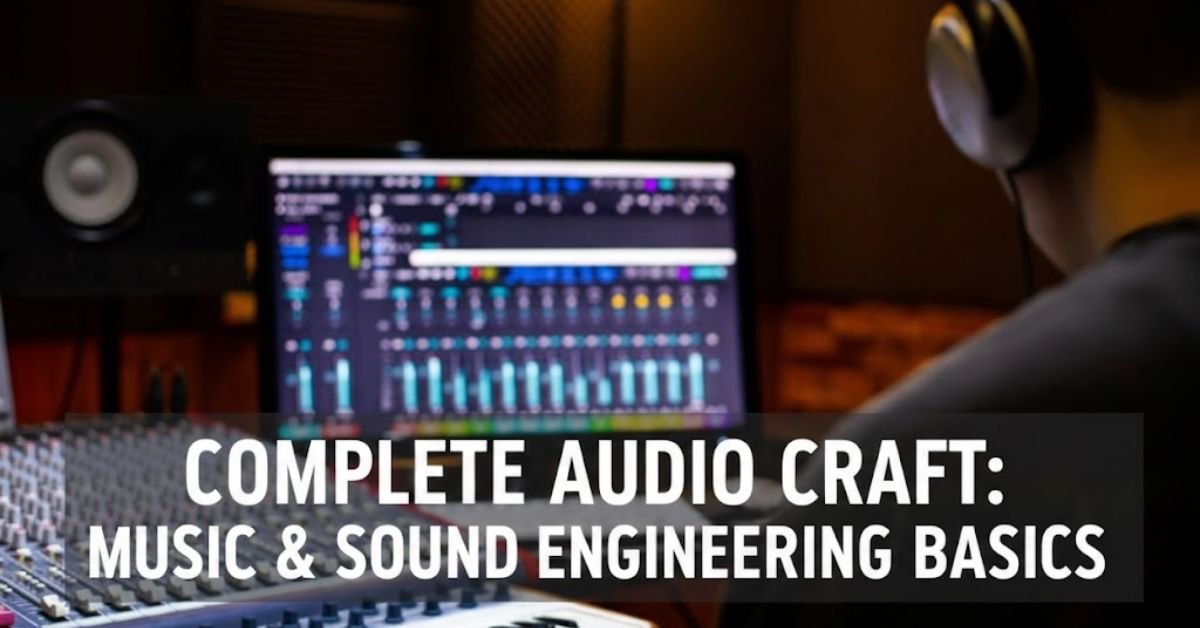

Music is still less a talent and more a technique, precision, and control. Whether it be recording vocals or designing immersive soundscapes, audio craft is the main driver of modern music creation. For creative talents who want to pursue music production courses in India, taking up sound engineering basics is definitely the most important step towards building a professional workflow that is efficient in different studios, stages, and digital platforms.
This blog imparts knowledge of music and sound engineering essentials with an emphasis on the skills that are of great use in production environments
Understanding Sound Before Shaping Music
Sound engineering depends heavily on the behavior of the audio. Frequency, amplitude, phase, and dynamics are the aspects that tell how a sound is heard, recorded, and changed. If you don’t have a good understanding of these features, then even the top gear won’t be able to give you the results that are of your expectation.
Some of the key concepts that an absolute beginner should understand are:
- How frequency ranges affect clarity and balance
- The role of dynamic range in clean recordings
- Phase alignment and its impact on stereo imaging
These basics serve as a roadmap for the making of the decisions at recording, mixing, and mastering.
Recording Techniques That Build Strong Foundations
Quality production starts with quality input. How the microphone is chosen, where it’s placed, and how the room is treated will have a very significant impact on the final sound. The engineers concentrate on getting the cleanest possible signal, which can be processed later without the need for a heavy fix in the post-production.
Some of the most significant recording considerations are:
- Using the right microphones for the characteristics of the voice or instrument
- Controlling room reflections and noise of the environment
- Establishing correct gain levels to prevent distortion
Good recording makes all the following stages of the work much easier.
Mixing: Creating Balance and Space
Mixing is the process through which individual sounds are combined to form one track, which is technically and creatively done simultaneously, thus, it requires the use of the listener’s intellect and the making of the controlled decisions. Equalisation helps the tonal balance to be more defined. Compression handles the loudness variations. Panning is responsible for the tracks’ width and separation.
Modern mixing is more about clarity, depth, and intention rather than over-processing. No one element of the music should be that of the arrangement which is fighting for the attention.
Mastering for Consistency and Delivery
Mastering is the final step that gets the music ready for distribution on streaming services, in movies, on TV, or even for playing live on different audio systems. It aims at maintaining the same tone throughout, having the volume under control and making the audio compatible with all the devices on which it can be played. Mastering isn’t really about changing the mix in a big way – it’s more about polishing.
Sound engineers evaluate:
- Volume levels that are acceptable for various platforms
- Sound quality when the audio is played on different kinds of speakers or headphones
- Complete technical specifications and file types for the final product
The Role of Technology in Modern Audio Craft
Audio professionals of today use DAWs, plugins, control surfaces, and hybrid studio setups. Along with technical fluency, creative instinct is also equally important. When engineers know the signal flow, digital processing, and workflow efficiency, they can switch to different genres and industries.
That is the reason why organized learning is still relevant.
Building Skills Through Professional Training
For those who are really determined to be a part of the industry, formal education is what helps you to go beyond the theory and apply it. Good audio engineering courses in India emphasize the use of studios for learning, actual equipment, and industry standard practices rather than just giving the theory from the surface.
An institute like ours, TASE, perceives the learning of audio as a skill, a skill that is developed through doing, trying out, and receiving help from the expert staff. By studying music production and sound engineering in a professional studio-like environment, students acquire the abilities which are directly transferable to the music, film, live sound, and media production industries.
One cannot learn the complete audio craft in a single day. It is acquired gradually, through organized learning and getting more practice from your previous knowledge, this is exactly the point where proper instruction makes all the difference.