

Do You Need Professional Music Education in the Digital Age?
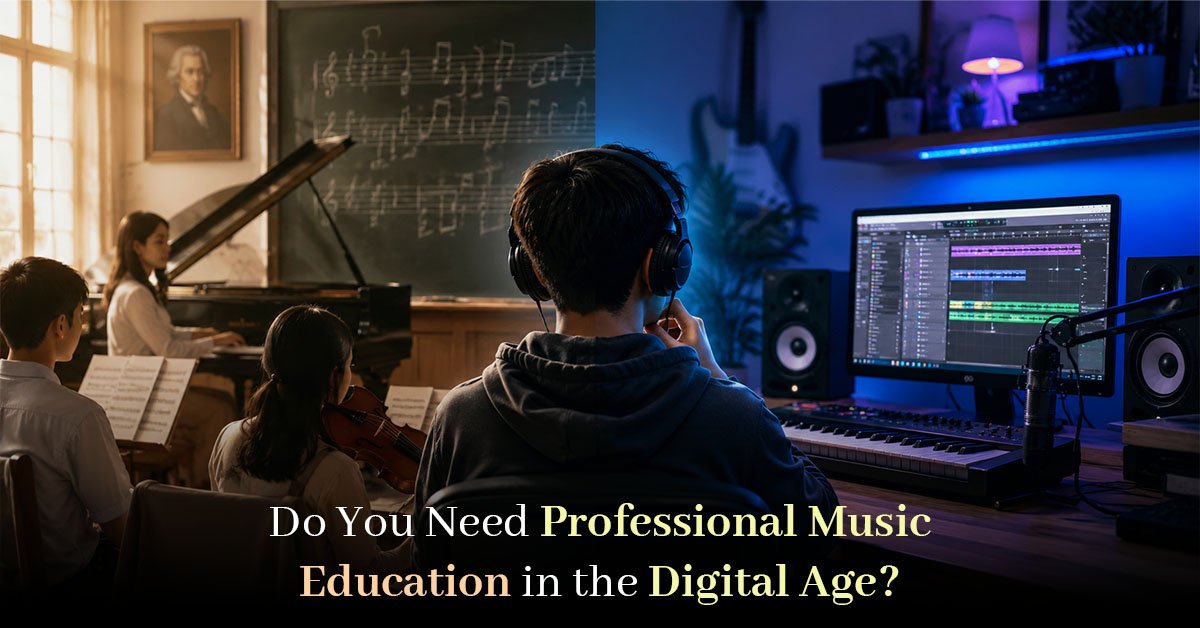

Anyone with a laptop and an internet connection can make music today. Free DAWs, YouTube tutorials, sample packs, and plug-in bundles have lowered the barrier to entry so dramatically that the question feels fair to ask: does formal music education still matter? The answer is more layered than a simple yes or no. The tools have changed. The fundamentals have not. And the gap between someone who sounds like they know what they are doing and someone who actually does is still very real. If you have been searching for Sound Engineering Courses in India and wondering whether a structured programme is worth your time, in this blog, we will take a closer look at what formal education actually gives you, where self-learning falls short, and why the distinction matters more than ever right now.
What Self-Learning Gets Right
There is real value in learning independently, and it would be dishonest to dismiss it. Platforms like YouTube, Coursera, and Splice have helped thousands of people develop genuine skills. Self-directed learners often build:
- A strong personal workflow shaped around their creative instincts
- Faster familiarity with specific tools and plug-ins
- The habit of producing consistently, which is a discipline in itself
The accessibility of information today is extraordinary. But information is not the same as education.
Where the Gap Shows Up
Here is the thing that most online tutorials will never teach you: context. Knowing how to use a compressor is different from knowing when not to use one, or why a particular signal chain sounds thin in a certain acoustic environment. Formal education teaches principles, not just steps.
In a structured programme, you learn signal flow, psychoacoustics, room acoustics, and the physics of sound before you start tweaking parameters. That foundation changes how you hear. It also changes how you problem-solve. A self-taught producer can spend hours chasing a problem that a trained engineer identifies in minutes, because they understand the source rather than the symptom.
There is also the question of feedback. Watching a tutorial gives you instruction. Working with an experienced faculty member gives you correction. Those are very different things.
Industry Standards Are Not Intuitive
The music and audio industry runs on standards. Whether it is broadcast loudness specs, film audio delivery formats, or mixing conventions for streaming platforms, there are technical parameters that matter commercially. Clients and studios expect professionals to know these without being told.
Formal training exposes you to these standards as part of the curriculum, not as an afterthought. You also get hands-on time with professional-grade equipment: analog consoles, high-end microphones, reference monitors, and acoustic spaces that cannot be replicated with headphones in a bedroom.
The Network Factor
This is perhaps the most underestimated advantage of structured education. The music industry, like most creative industries, runs heavily on relationships. Studying at a credible institution puts you in the same room as working professionals, visiting artists, and peers who will eventually be your colleagues, collaborators, and referrals.
Online learning platforms can teach you skills. They cannot replicate that network.
Does It Have to Be One or the Other?
No. The most capable audio professionals today tend to combine both. Formal education gives them the framework. Independent exploration keeps them current. The digital tools change fast. Core principles do not. That balance is what produces engineers who can adapt without losing precision.
At TASE, The Audiophile’s School of Sound Engineering, we have always believed that passion needs structure to become a profession. Our Music Production Courses in Chennai are built the way the industry actually works. You get real studio time, guidance from certified professionals, and a curriculum that meets international standards, not one designed around textbooks alone. We do not just teach you how to use software. We train you to understand sound, which is a different level of skill entirely. If you are serious about building a career in audio, formal education is not a detour from your goals. It is the most direct route to them. TASE is here to walk that path with you.