

How AI and Technology Are Transforming Music Production in 2027
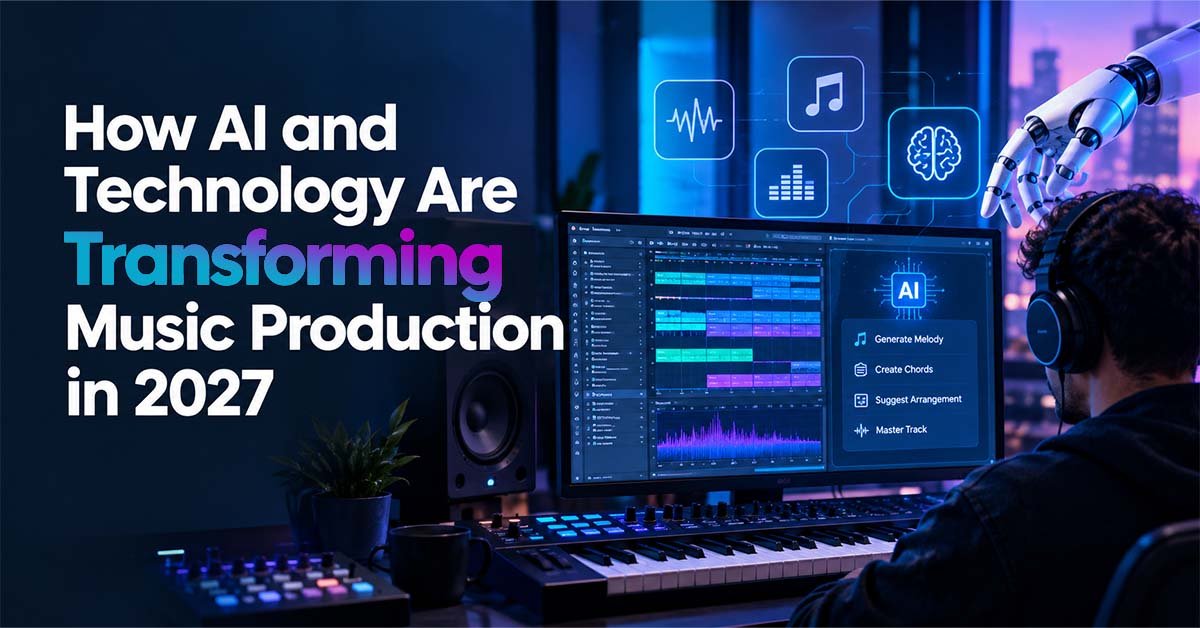

A bedroom producer finishes a vocal take at midnight, drops it into a session and, within seconds, has the harmony stack, a rough mix and a mastered preview playing back. Five years ago, that same job took a weekend and a studio booking. The tools have changed fast, and so has the question every young producer now asks: if software can do so much, what is left for a human to do?
This article looks at where AI and technology are changing music production going into 2027, including songwriting aids, stem separation, mixing and mastering assistants, sound design, cloud collaboration and immersive audio, along with the limits, the ethics and the skills that still matter. If you are comparing music production courses In India, it will help you see what a modern curriculum should cover.
From Plug-Ins to Partners: How the Toolbox Changed
For years, music software was passive. You pressed a key, and it made the sound you asked for. The newer generation of tools behaves differently. It listens to what is in your session, makes suggestions and sometimes completes tasks on its own.
Three shifts explain most of the change. Processing power is cheap enough that heavy analysis runs on an ordinary laptop. Machine learning models trained on huge sets of audio can recognise instruments, chords and rhythm patterns. And cloud services let large tasks run remotely, so a modest setup can reach results that once needed expensive hardware.
The outcome is a workflow where the producer spends less time on repetitive chores and more on decisions about taste, feel and direction.
Writing and Arranging With a Digital Collaborator
Ideas are where many sessions stall, and this is where AI tools have been adopted most eagerly.
- Chord and melody assistants suggest progressions and variations when a writer is stuck
- Drum and bass pattern generators offer starting grooves in a chosen style and tempo
- Arrangement tools show how a track might build, drop and resolve across sections
- Lyric helpers offer rhyme options and alternative phrasing
- Reference matching compares a draft with a chosen track to flag differences in structure and energy
The sensible way to use them is as a sketchpad. A generated idea is rarely finished, but it can break a creative block. Producers who copy output without shaping it tend to end up with tracks that sound like everyone else’s.
Stem Separation, Cleanup and Restoration
One of the most practical advances has been the ability to pull a finished song apart. Modern separation tools can split a mix into vocals, drums, bass and other parts with surprising clarity.
This changes everyday work. Remixers can isolate elements for creative use, where rights allow. Engineers can rescue recordings with background noise, hum or a clipped peak. Film and podcast editors can remove unwanted sounds from dialogue. Archivists can restore old recordings that once seemed beyond repair.
The results are not perfect, and artefacts can creep in, especially with dense mixes. A trained ear is still needed to judge whether the cleaned audio is good enough to use.
Mixing and Mastering Assistants
Automatic mixing and mastering services have moved from novelty to normal. They analyse a track, set levels and equalisation, and return a polished version in minutes.
For independent artists on a budget, this lowers the barrier to a release-ready sound. For professionals, assistants speed up the first pass, so more time can go to the details that matter: balance, space and emotion. Intelligent plug-ins now suggest equaliser curves, detect masking between instruments and match loudness to streaming targets.
The limitation is context. A tool does not know that a song is meant to sound raw, or that a vocal should sit slightly behind the band for effect. Treat these assistants as a starting point, and always compare the result against your own judgement.
Sound Design and Virtual Instruments
Synthesisers and sample libraries have also become smarter.
- Search tools find sounds by description or by humming a reference
- Generative synths create new textures from text prompts or audio examples
- Virtual instruments capture performance nuance, such as bow noise or breath, with far more realism than before
- Voice models can create backing vocals or demo singing from text and melody input
- Adaptive tools shape sounds to match the key and tempo of the project
These tools widen the palette, and they raise a question about originality. A sound that anyone can generate with the same prompt is not a signature. Distinctive producers still record, process and layer their own material to build an identity.
Remote Collaboration and Cloud Workflows
Music is rarely made alone any more, and technology has made distance matter less.
Cloud sessions let producers in different cities work on the same project, with version tracking and comments. High-quality remote recording tools let a vocalist record in one place while a producer monitors in another. Shared sample libraries and project files keep teams aligned, and mobile apps let ideas be captured on the move and moved into a full session later.
Good habits matter here: clear file naming, consistent sample rates and backups. A fast tool does not help if nobody can find the right version of a track.
Immersive Audio and New Ways of Listening
Delivery formats are changing too. Spatial and immersive mixes, such as Dolby Atmos, are now common on major streaming platforms, and many listeners hear them through ordinary headphones. Object-based mixing lets sounds be placed above, behind and around the listener.
For producers, this means learning to think in three dimensions and to check that a mix still works in stereo. Tools that preview binaural rendering and automate object panning make it easier to start, though careful monitoring remains essential. Live performance is changing as well, with multi-speaker venues and interactive installations using the same techniques.
Ethics, Ownership and the Limits of Automation
Technology brings questions that producers cannot ignore.
- Training data: Many AI models learn from existing music, and the rules about permission and credit are still being settled
- Voice likeness: Cloning a singer’s voice without consent raises legal and moral problems
- Credit and royalties: It is unclear how to split credit when a tool contributes to a composition
- Platform rules: Streaming services are updating policies on AI-generated content and disclosure
- Sameness: If everyone uses the same shortcuts, music risks sounding alike
Staying informed about licences and platform policies is now part of a producer’s job. Using tools openly, with proper permissions, protects both the artist and the audience’s trust.
Skills That Still Set Producers Apart
Automation handles tasks, but it does not replace judgement. The skills that keep their value are the ones that sit above the tools.
- A trained ear that can hear what is wrong and what to fix
- Understanding of acoustics, monitoring and signal flow
- Solid mixing fundamentals, so automatic results can be judged and improved
- Taste and the ability to make bold, deliberate choices
- Communication with artists, who need a collaborator and not just a technician
- Willingness to keep learning as software changes every few months
Hands-on practice remains the fastest route to these skills. Working on real sessions, with feedback from experienced engineers, builds instincts that no prompt can supply.
Learning in a Studio Built for the Modern Producer
The Audio Sound Engineering academy, TASE, trains students in music production and sound engineering through diploma programmes taught in working studio settings. Its courses cover recording, mixing and mastering, with practical sessions on professional equipment.
A studio-based course lets students learn the fundamentals first and then apply new tools with a trained ear guiding them. That balance matters in a year when software is changing faster than any syllabus can list.
The Human Ear Still Has the Final Say
Technology will keep getting faster, and producers who use it well will work quicker and reach more listeners. What will not change is the need for someone to decide what a song should feel like. Learn the tools, but learn the craft first, and the tools become allies instead of replacements. For anyone ready to build that foundation in a major music hub, explore sound engineering courses in Bangalore and see how a structured programme can take you from the basics to professional-level production.