

How to Mix Vocals for a Professional Sound
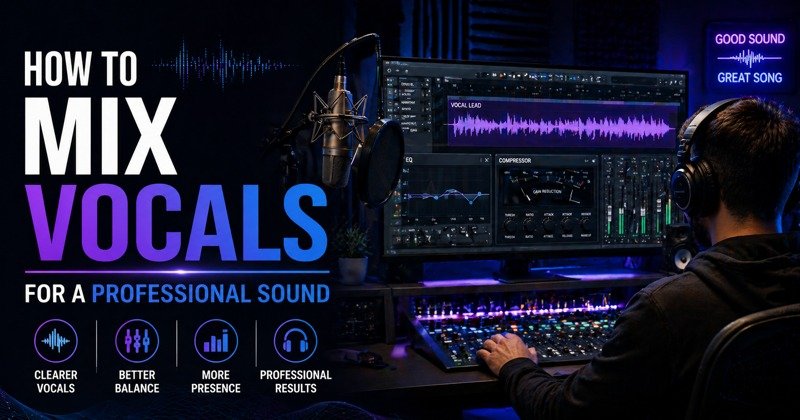

Vocals carry the weight of a song. The emotion, the story, the whole point of the track usually lives in the vocal. So when it does not sit right in the mix, everything feels off. A lot of producers struggle with this, not because they lack talent, but because vocal mixing involves more steps than most people expect. If you are going through music production courses in Bangalore or figuring things out on your own, getting comfortable with this process will immediately lift the quality of your work. In this blog, we will take a closer look at what it actually takes to mix vocals to a professional standard.
Start with a clean recording
This sounds obvious, but it gets skipped more often than it should. No plugin or processing chain fixes a recording that was done poorly. Background noise, inconsistent performance, mic placement issues, these all show up later and make every step harder. Before you even think about mixing, make sure the vocal was recorded well. A clean source makes everything downstream easier and the final result much better.
Editing before processing
Editing is the part that does not get talked about enough. Before any processing touches the vocal, the performance needs to be cleaned up properly. This is where most of the groundwork happens.
- Remove breaths, clicks, and room noise between phrases
- Fix timing so the vocal feels natural against the groove of the track
- Apply pitch correction where needed, but keep it light enough that the performance still feels like a person sang it
When the edit is done right, your processing has something solid to work with.
EQ and Compression
These two do most of the heavy lifting in a vocal mix. A high pass filter clears out the low end rumble that sits below the vocal and only muddies the mix. From there, EQ helps carve out problem areas, usually somewhere between 2 and 4 kHz where harshness tends to build up. A gentle boost in the upper midrange adds presence and helps the vocal cut through without feeling sharp or aggressive.
Compression handles the dynamic range. Vocals move around a lot in terms of volume, some lines hit harder, some feel pulled back. A compressor smooths that out so the energy stays consistent from verse to chorus without making the vocal sound processed or flat.
Reverb and Delay
These are the tools that give a vocal its sense of space. A dry vocal with no reverb sounds like it was recorded in a box. Too much reverb and it disappears into the background. The balance is everything. A short room reverb works well for tracks that need intimacy. Longer reverb tails suit more cinematic or emotional moments. Delay adds movement and width, a quarter note or eighth note repeat can make a vocal feel alive without cluttering the rest of the mix.
Fitting the vocal into the full mix
Solo mode is useful, but it can mislead you. A vocal that sounds perfect on its own often needs adjustment once the full mix is playing. Automate the vocal level so it stays present through quieter sections and does not get swallowed during a dense chorus. Check the mix on headphones, on speakers, and even on your phone. Each one tells you something different about where the vocal is sitting.
Vocal mixing is not something you figure out once and then forget about. Every track is different, every voice behaves differently, and the only way to get better at it is to keep working at it with intention. If you want to actually get better and not just go through the motions, TASE offers music production courses in Chennai that focus on real skill building, the kind that holds up when you are working on actual projects.